How MOTS-c Works at the Mitochondrial Level: The Five Mechanisms Behind Better Energy, Recovery, and Performance
When patients ask me what makes MOTS-c different from stimulant-based supplements, I point to one fundamental difference: MOTS-c works at the source of cellular energy production itself. This isn't about masking fatigue with caffeine or forcing your body into overdrive. It's about optimizing how you
When patients ask me what makes MOTS-c different from stimulant-based supplements, I point to one fundamental difference: MOTS-c works at the source of cellular energy production itself.
This isn’t about masking fatigue with caffeine or forcing your body into overdrive. It’s about optimizing how your mitochondria—the power plants inside every cell—generate and use energy.
After working with weightlifters, MMA fighters, and patients fighting stubborn fat loss plateaus, I’ve seen how understanding these mechanisms changes everything. One patient told me: “Wow I can’t believe how good I feel taking this MOTS-c. My abdomen looks tighter and my energy and focus is insane!”
Here’s what’s actually happening inside your cells.
Mechanism #1: AMPK Activation—Your Body’s Metabolic Master Switch
MOTS-c activates AMP-activated protein kinase (AMPK), often called the body’s “master metabolic switch.”
Think of AMPK as the decision-maker that determines whether your body stores energy as fat or burns it as fuel. When MOTS-c inhibits the folate cycle, it causes AICAR to accumulate—a natural compound that potently activates AMPK without stimulants.
Once activated, AMPK signals your body to:
- Prioritize burning fat for fuel rather than storing it
- Suppress the synthesis of new fats, particularly in the liver and visceral areas
- Shift from energy storage mode to energy utilization mode
This is why patients report sustained energy without the crash. You’re not forcing energy production—you’re optimizing the existing system.
Mechanism #2: Enhanced Fatty Acid Oxidation—Turning Stored Fat Into Fuel
MOTS-c increases fatty acid oxidation by upregulating carnitine shuttle proteins and β-oxidation intermediates.
In plain language: more fats get transported into your mitochondria and burned for energy instead of being stored.
We had a patient stuck at a fat loss plateau for over a year. They wanted to lose 10-15 pounds but nothing worked. Within 12 weeks on a protocol that included MOTS-c and proper nutrition, they achieved their goal.
The key wasn’t just the peptide—it was the combination of MOTS-c optimizing fat oxidation while they maintained adequate protein intake to preserve muscle mass.
Research in mice on high-fat diets showed MOTS-c administration prevented weight gain, reduced fat accumulation, and improved metabolic parameters by shifting cellular metabolism toward efficient fat utilization.
Mechanism #3: Mitochondrial Efficiency—Better ATP Production and Recovery
Your mitochondria produce ATP—the energy currency your cells use for everything from muscle contraction to brain function.
MOTS-c improves how efficiently your mitochondria produce ATP, especially during metabolic stress.
In diabetic heart tissue studies, MOTS-c restored mitochondrial respiration capacity and reduced ATP waste during oxygen-deprived conditions without compromising ATP production during normal conditions.
This protective mechanism means you conserve energy during stress while maintaining optimal cellular ATP levels during recovery. For athletes, this translates to:
- Extended training output without hitting the wall
- Faster recovery between sessions
- Sustained performance across longer workouts
The weightlifters and MMA fighters I work with notice significant energy increases in training sessions along with quicker recovery times.
Mechanism #4: Nuclear Translocation—The Smart Stress Response
Here’s where MOTS-c gets interesting.
Under metabolic stress—exercise, fasting, or aging—MOTS-c moves from the mitochondria into the cell nucleus where it regulates genes containing antioxidant response elements.
It interacts with stress-responsive transcription factors like NRF2, coordinating adaptive responses that protect cells from oxidative damage and metabolic dysfunction.
This nuclear regulatory feature allows MOTS-c to act as a smart response system, adjusting cellular defenses based on the stress your body faces.
It’s not just providing energy—it’s protecting the machinery that produces energy.
Mechanism #5: Exercise Mimicry and Performance Enhancement
Exercise naturally induces endogenous MOTS-c expression in both skeletal muscle and circulation, creating a positive feedback loop.
MOTS-c essentially mimics and amplifies the metabolic benefits of exercise at the cellular level.
Studies show MOTS-c treatment improved physical performance across all age groups—young, middle-aged, and old mice demonstrated significantly enhanced endurance and exercise capacity.
But here’s what matters for you: MOTS-c levels naturally decline with age, dropping by approximately 21% in individuals aged 70-81 compared to those aged 18-30.
Late-life intermittent MOTS-c treatment (administered 3 times per week) significantly enhanced physical capacity and healthspan in aged mice. In humans, circulating MOTS-c levels are lower in type 2 diabetes patients compared to healthy controls.
What This Means for Your Protocol
At Recovery Room, we administer MOTS-c via subcutaneous injection on a 20-day cycle—taken once every 5 days for 20 days total, repeated 2-3 times per year.
Most patients report feeling changes within 4-12 weeks, though some notice improvements as early as 2-3 weeks.
The timeline varies because everyone’s starting point is different. Your mitochondrial function, current metabolic health, lifestyle factors, and age all influence how quickly you respond.
This isn’t an instant solution. Anyone expecting overnight results will be disappointed.
But if you’re willing to commit to the protocol while maintaining proper nutrition and training, the mechanisms I’ve outlined here work together to optimize your cellular energy production at the source.
Who MOTS-c Isn’t Right For
We don’t recommend MOTS-c if you have:
- An active history of cancer
- Pregnancy or breastfeeding status
- Current use of AMPK-activating medications
- Professional athlete status without clearance from testing agencies
During your consultation, our physician reviews your complete medical history, current medications, recent labs, lifestyle factors, and specific goals to determine if MOTS-c fits your individual situation.
The Bottom Line
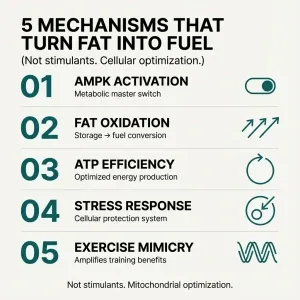
MOTS-c works because it addresses cellular energy production at five distinct levels: AMPK activation, fatty acid oxidation, mitochondrial efficiency, stress response coordination, and exercise mimicry.
These mechanisms work together to shift your metabolism from storage mode to utilization mode—burning fat for fuel, producing ATP more efficiently, and protecting your cells from oxidative stress.
The patients who see the best results are those who understand this isn’t a shortcut. It’s an optimization tool that works when combined with proper nutrition, consistent training, and realistic expectations.
If you’re serious about optimizing your biology without stimulants or shortcuts, these five mechanisms explain why MOTS-c is gaining attention among those committed to doing the work.